
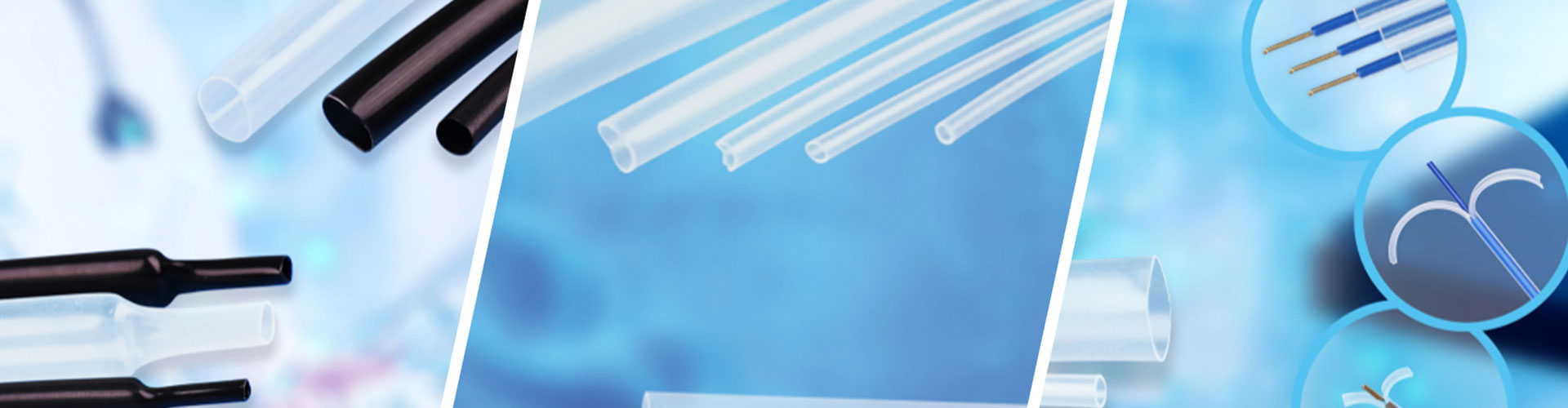
For the manufacture of medical equipment (thin-walled heat-shrinkable tubes)
2025-04-24
Special sections:
Reducing the size of the device is one of the advantages of shrink tubes and has a wide range of applications.
The need for minimally invasive medical surgery is a major driver of the modern medical device industry. Smaller is finer, the better, especially in catheters, endoscopes and other devices inserted into the body. Designers are looking for new ways to reduce the size of existing devices and develop new minimally invasive devices. The industry is also facing pressure to create more features for devices without increasing size. Thin-wall heat shrink tubing is a product that can help designers meet this need by reducing diameter and improving the manufacturing process. The benefits of using this type of piping include:
- Pipe connection (variable stiffness pipeline)
2. Electrical insulation.
- Packaging and protective layer.
- Related components.
- Pipeline connections and transitions.
- Marking and printing.
- Formation of catheter tips.
- Micro hose hoops.
- Protective coating.
This article compares the basic properties of thermoplastic materials used to make high-quality medical shrink tubing, including polyolefins, fluorinated polymers (PTFE), polyvinyl chloride (PVC), and polyesters, especially polyethylene glycol ethers (PET), and highlights some of the more interesting applications for product design, especially using PET.
Comparison of materials
Table 1 compares the characteristics of the main materials used to make thin-walled heat shrink tubing. It is 10 - 100 times thinner than any other heat shrink tubing and more than 10 times stronger than any other heat shrink tubing. PET can produce pipe walls from 00015 to 0004 inches while maintaining high peripheral strength compared to PTFE tubing over 0002 inches and polyolefins and PVC over 0005 inches. Polyesters also offer excellent flexural fatigue properties and the lowest shrink temperatures (185°F / 85°C) for conventional materials without the concern of thermal decomposition effects on brittle substrates.
Table 1: Comparison of materials used for the production of thin-walled heat-shrinkable pipes.
Despite its excellent lubrication, one of the significant disadvantages of PTFE is its very high compression temperature, about 315°C, which makes it unsuitable for use with plastic catheters and other plastic parts. PTFC cannot be sterilized using gamma rays, which is a barrier in some markets that are moving away from epoxyethane. The walls cannot be as thin as polyester pipes, but still maintain useful strength with a high tolerance for wall thickness. Compressed PTFE tubes are commonly used as the internal lining of the device, as well as the cover of metal parts and equipment.
二、 Features of PET heat shrink pipes
The key properties of polyester heat shrink tubing are shown in Table 2. The shrinking rate of polyester tubing is a function of temperature: the higher the temperature, the higher the shrinking rate. The compression temperature of PET ranges from 85°C to 190°C. Without restrictions, pipelines will compress radially and axially, achieving optimal overall performance with minimal contraction (less than 15 - 20%). As long as very high radial shrinkage (up to 70%) is required, the pipe can be drawn when heated. Pull the pipeline to achieve very high radial contraction while maintaining the ability to hold thin walls.
This is a unique polyester fiber.
Table 2: Properties of heat-shrinkable polyester (PET) pipes.
三、Application of heat shrink pipes
Application 1: Connection of pipelines (pipes with variable stiffness). Due to their ultra-thin wall, polyester heat-shrink tubing can be used to increase catheter hardness without significantly increasing the size of the device. Using different thicknesses of pipe along the length of the pipeline can provide varying degrees of flexibility to improve control of the device. This quick and easy piping application eliminates the need to join different materials or add braided materials to sections of piping to achieve multiple hardness areas. For example, 1 mil heat shrink tubing may be placed at the end of the catheter, 1/2 mil heat shrink tubing in the middle, 1/4 mil heat shrink tubing near the end and no heat shrink tubing at the tip. This provides the flexibility needed for varying degrees of hardness and tip length.
Application 2: Electrical insulation. Almost every type of heat shrink tubing is used for electrical insulation. Material selection is usually based on temperature, dielectric strength, cost and wall thickness. High dielectric and resistive properties make polyester heat-shrinkable tubing an effective electrical insulating material, the size of which practically does not increase due to its thin wall. For example, it can be used on needles to protect the skin surface from burns during electrical stimulation, and can also be used effectively to coat wires on electronic components or insulating catheters and other devices. Some manufacturers use PET tubing to electrically insulate metal axles instead of a coating process. The use of polyesters significantly reduces the likelihood that needles may sometimes form on the surface of the coating.
Application 3: Protective layer, coating and bonding. Polyester heat shrink tubing is commonly used to cover the shafts of braided catheters, snap rings, opaque marking tapes, and other components that require a thin, durable protective layer. The tubing allows a smooth transition on sharp edges and can be sealed to prevent fluid leakage. For example, it is placed on a rotating spring cutter to prevent debris from clogging the reel and to serve as a support surface within the device. Thermal capacitors provide a liquid seal, but the cutter remains flexible. Different compositions of heat shrink tubing are used for different stress release applications. Many applications require thick and flexible materials, while others require thinner, stiffer pipes. Polyester heat shrink tubing can be used to reduce the deformation of catheters and other tubing to prevent distortion. Knitted catheters tend to distort at the end of the fabric, but shrink tubing provides quick and easy-to-use reinforcement and a smooth transition on both surfaces. Repeatable and consistent shrink tubing is again becoming an effective coating alternative, eliminating solvents and other chemicals and providing an internally uniform surface.
By bundling various components (other tubes, wires, optical fiber, etc.) into the smallest possible space using shrink tubes, it is possible to reduce the size of the endoscope and other devices or add more functions without increasing the overall size of the instrument. The connecting tubes at the end of the device can also be made of thin-walled polyester to save valuable space. Typically, enough space can be freed up to add another working channel to the endoscope or allow the designer to reduce the size of the entire device.
Appendix 4: Pipeline connections. Polyester and fluoropolymer heat shrink tubing (usually FEP) are used to weld pipes together. Typically, pipes with different characteristics (rigid and flexible) are connected together. A simple way to achieve this is to insert a metal rod into the end of the tube to prevent them from collapsing, connect the ends together, and then compress the tube at the top. Because of the low shrink temperature of polyester pipe, components do not deform during initial application as the shrink process compresses the pipe and seals it tightly during melting. Considering the high melting point of polyester, the high temperature tube used at the end of the melting tube will not melt the shrink tube. After connecting the pipe, you can save or detach the heat shrink tubing, leaving a super-smooth clean surface; An incision at the end of the tapered tube before cutting can help remove. Because the tube is transparent, the operator can see when the tube is melting. The ability to control this process is very useful in product development and production because it avoids using too much or too little heat.
Application 5: Pipe marking and printing. Almost all types of heat shrink tubing can be used to mark and print tubes, with the exception of PTFE (as any type of ink is difficult to combine with PTFE). Using heat shrink tubing, depth marks and printing can be easily added to catheters and metal axles. Typically, thin strips of colored heat shrink tubing can be precisely identified and used for marking. Label information can be added by pre-printing on shrink tubing and then applied to the product without the need to send the device itself to the printer for labeling or transport printing inks and solvents to the production facility for in-house printing. Some products, such as HDPE catheters, cannot be easily printed without surface treatment, adding complexity. A manufacturer printed on a product can place clear heat shrink tubing on the printing surface for protection without significantly increasing the diameter of the product.
Application 6: Forming pipe ends. The low shrinkage temperature and high melting point of polyester heat shrink tubing make it effective for forming smooth conical tips at the end of catheters. In the initial operation, a section of heat-shrink tubing is slid toward the end of the catheter, leaving a tail at the end. The rod is then inserted into the catheter to maintain the internal diameter of the tip and heat is applied to compress the tube to the base. Once the pipeline is connected, it will increase the heat to melt and flow the base material. Pull the heat shrink tubing towards a very thin and smooth tip. Again, since the tapering tube is transparent, the operator can easily monitor the process. Finally, remove the heat shrink tubing to complete the job.
Appendix 7: Miniature Hose Clamps. Polyester heat shrink tubing can be used as a tiny hose clamp on a ball catheter to increase adhesive strength and help prevent failure under pressure. Place a thin tube on the end of the balloon. Due to its high peripheral strength, polyester can clamp parts like a hose clamp, enhancing the grip and preventing it from falling out. It also provides a smooth transition without significantly increasing the clutch diameter. Tubing can also be used to connect fabrics, snap rings and other components to ensure a smooth transition.
Appendix 8: Shading process. A simple but very effective application of polyester heat shrink tubing involves covering the area while the coating is in operation. For example, a manufacturer may require a white coating on a clear balloon, but the neck must be left uncoated in order to attach it to the catheter using an ultraviolet hardener. Apply heat shrink tubing to the neck and then plunge the balloon into the covering. Once dry, the tube is peeled off, leaving the neck uncovered. The key to this application is the thinness of the polyester pipes; Thicker heat shrink tubes leave ridges of covering material on the balloon.
In another recent application, a manufacturer had to apply a smooth coating to a wire with a thin snap ring at the end of the segment. Polyester heat shrink tubing is used to cover the spring to prevent it from being coated during immersion. When the shrink temperature is low, shading is allowed without causing thermal deformation of the coil, tight contraction can prevent the coating from getting into the spring. At the end of the process, the polyester tube simply peels off.
四、 Conclusions
Although some applications and many of the specific applications discussed herein are only applicable to polyester heat shrink tubing, other heat shrink materials can be used, including polyolefins, fluoropolymers, and PVC. All these materials are used in the production of medical equipment. PET heat shrink tubing is especially useful because it can be made from ultra-thin walls. Other pipes tend to be too thick: Designers don't have enough space to accommodate tapering pipes with wall thicknesses greater than 0001 inches. The ultra-thin walls and other characteristics of PET tubing make it a valuable tool for designers trying to rethink the way medical devices are made.
To purchase medical thin-walled PET heat shrink tubes, PEBAX heat shrink tubes and polyolefin heat shrink tubes, contact KEYUACE.